
Power Factor Panel Repair Service in Noida
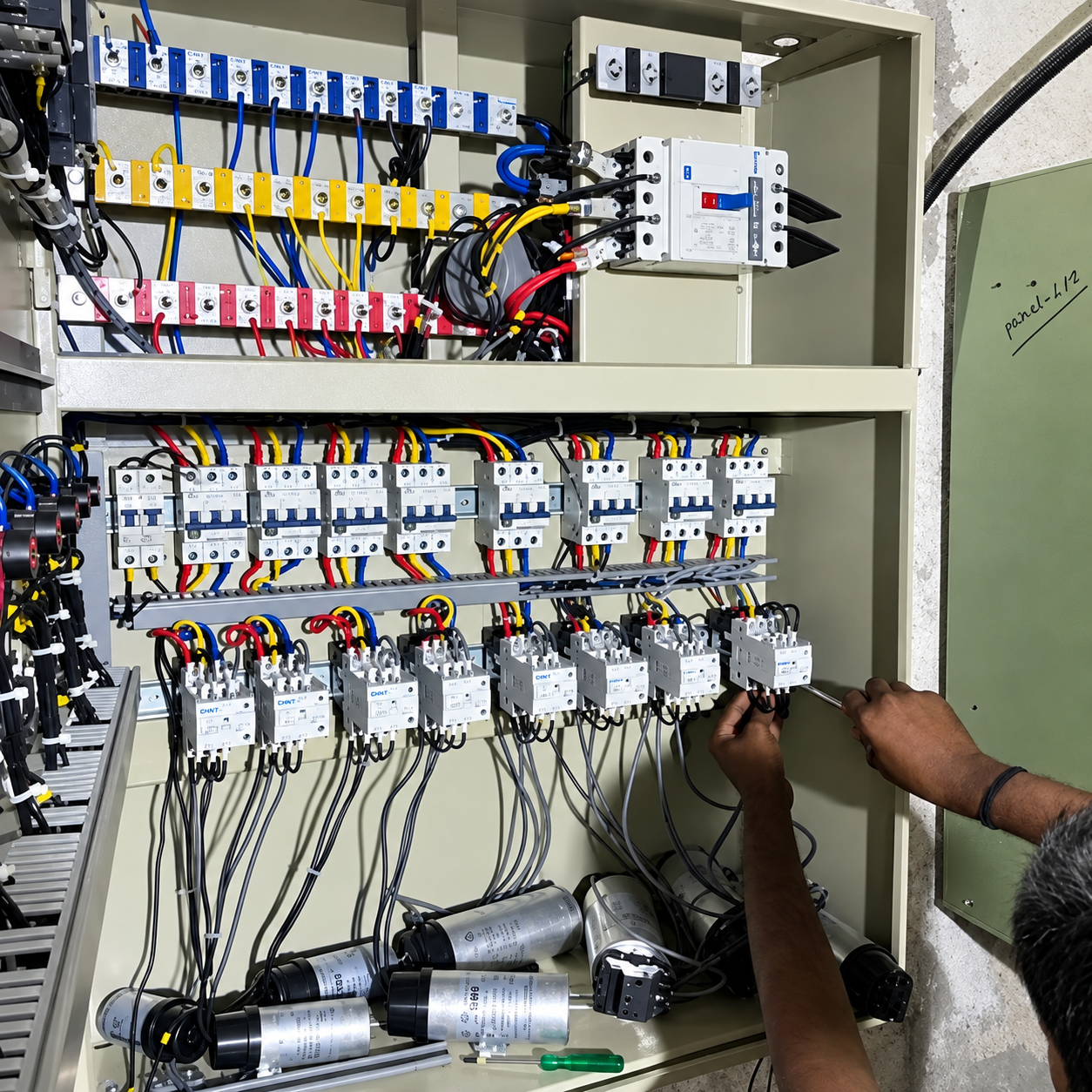
Dependable Power Factor Panel Repair Service in Noida
Noida has evolved into one of the most electricity-hungry cities in the National Capital Region — IT and BPO campuses in Sector 62 and the 125-135 corridor, electronics and mobile manufacturing units in Sector 63 and 64, the print and packaging belt around Sector 63 and the Hosiery Complex, media houses in Film City, hospitals in Sector 30 and 62, five-star hotels and malls along the Sector 18 corridor, and a dense web of warehousing and logistics parks stretching from Sector 71 to Noida Extension and Bhangel. Every one of these facilities depends on a power factor correction panel quietly keeping reactive power in check and keeping PVVNL's penalty lines off the monthly bill. When that panel starts drifting, the effect is immediate: falling PF readings, trip-outs during motor start-ups, burnt contactors and a demand charge that quietly climbs.
Our engineers at Transparent Infra And Energy Solutions provide a purpose-built Power Factor Panel Repair Service in Noida for industrial, IT and commercial sites that cannot afford extended outages. We diagnose what has actually failed — capacitor stage, APFC relay, capacitor duty contactor, CT polarity, busbar termination or harmonic resonance — and correct it with properly rated components. Every repair is verified under the site's own load before we hand the panel back to your maintenance team.
Book a Repair Visit ↗What a Power Factor Panel Does — And Why the Repair Has to Be Done Properly in Noida
Before you book a power factor panel repair service in Noida, it helps to see the panel for what it is: a small switching assembly that controls a very large share of your electricity bill, your transformer loading and your PVVNL compliance position. Panels that are "made to work again" without proper diagnosis often look fine on the controller display while quietly running below target PF for months.
A power factor panel — in most Noida facilities an Automatic Power Factor Correction (APFC) panel — is an electrical assembly that switches capacitor stages in and out of the circuit in response to changing load. Its purpose is to supply reactive power locally so that the plant draws less reactive power from the PVVNL grid and keeps the power factor close to unity.
A typical Noida APFC panel contains an APFC relay or controller, current transformers for load measurement, capacitor duty contactors to switch each stage, HRC fuses and MCCBs for protection, capacitor banks (usually MPP or heavy-duty type), busbars, control wiring, indicators, and in harmonic-heavy units detuned reactors. Each of these components ages on a different curve — capacitors dry out, contactors weld, relays drift, fuses blow and busbar joints loosen.
Noida's load profile stresses panels in very specific ways. IT and BPO campuses in Sector 62 and the 125-135 corridor run UPS-backed server loads, high-efficiency HVAC chillers and VFD-driven pumps that inject harmonic distortion into the panel network. Electronics and mobile-manufacturing plants in Sector 63 and 64 run SMT lines, burn-in racks and test benches with switched-mode power supplies that produce high THD-I. Print and packaging units in the Hosiery Complex combine large AC motors with rectifier-driven presses. Hospitals in Sector 30 and 62 run imaging equipment, OT loads and central AC. Each of these stresses capacitors and contactors differently, which is why a proper power factor panel repairing service in Noida starts with a short power-quality snapshot rather than a straight replacement guess.
Deferring a repair has a cost that is easy to measure — PVVNL low-PF penalties, inflated kVA demand charges, nuisance tripping at peak load, transformer and cable overheating — and a cost that is harder to measure: shortened equipment life, unplanned downtime and a growing risk of fire at a burnt terminal. None of these is worth postponing.
Components We Verify in Every Noida Panel
- APFC Relay / Controller — target PF, step delays, CT ratio and number of steps.
- Current Transformers (CTs) — ratio, polarity, phase identification and wiring.
- Capacitor Duty Contactors (CDCs) — duty rating, contact condition, coil voltage and pre-charge resistor.
- Capacitor Banks — capacitance, ESR, physical condition and per-stage kVAr.
- HRC Fuses & MCCBs — rating, coordination and fault-level suitability.
- Busbars & Control Wiring — torque, insulation resistance and termination quality.
- Detuned Reactors — tuning percentage and physical condition, where fitted.
- Cooling Fans & Ventilation — airflow, filter condition and internal temperature.
- Discharge Resistors — intact and correctly sized to allow safe re-switching.
Why Timely Power Factor Panel Repair Matters in Noida
A failing power factor panel is not a "watch it for a while" problem. For a Noida plant on an HT industrial connection with a large connected load, or an IT campus with a 2,000 kVA transformer, every week of deferred repair adds directly to the bill and increases the risk of a full panel failure during a production or service window.
1. Avoid PVVNL Low-PF Penalties
Noida consumers are billed by Paschimanchal Vidyut Vitran Nigam Limited (PVVNL) under UPERC tariff orders. PVVNL applies reactive-power charges and low-PF penalties when power factor falls below the notified threshold. A panel that has lost two or three capacitor stages can push PF below that threshold within a week — with significant avoidable charges on the next industrial bill.
2. Reduce kVA Demand Charges
Most Noida industrial and commercial tariffs bill maximum demand on kVA rather than kW. Correcting the power factor reduces the kVA drawn from the grid for the same useful work, so the recorded maximum demand falls and the monthly demand charge drops with it.
3. Protect Transformers and Cables
Low power factor means higher current for the same kW load. Transformer windings, cable insulation and switchgear all run hotter, age faster and lose usable capacity. A repair restores normal current and relieves the entire distribution system — critical in Noida where many facilities run transformers close to their rated capacity during peak hours.
4. Stop Nuisance Tripping
Over-compensation during light-load periods, harmonic resonance or a mis-calibrated relay can all cause unexplained tripping of capacitor breakers, the main incomer or downstream machinery. Repair with proper diagnosis removes the cause rather than re-setting the breaker each shift.
5. Extend Capacitor Life
When the relay is drifting or a CT polarity is wrong, capacitors switch erratically and fail early. One capacitor replacement after such a failure costs more than a calibration visit would have, and it takes production or service downtime for the same number of hours.
6. Reduce Fire Risk from Burnt Terminals
Loose busbar joints and undersized contactors are the most common cause of burnt terminals and panel fires in Noida's older industrial sheds around Sector 63 and the Hosiery Complex. A comprehensive power factor panel repair in Noida includes re-termination, re-torquing and a thermal scan, not just a component swap.
Types of Power Factor Panels We Repair Across Noida
From compact panels in older Sector 63 workshops to large multi-stage panels in Sector 62 IT towers and Sector 64 manufacturing plants, every common configuration is covered by our service scope.
| Panel Type | Typical Noida Application | Common Repair Scope |
|---|---|---|
| Automatic APFC Panel | IT campuses, industrial units, malls, hospitals | APFC relay, CT, CDC, capacitor stage repair & re-commissioning |
| Fixed Capacitor Panel | Small workshops in Sector 63, pump houses, cold stores | Capacitor replacement, fuse and MCCB repair |
| Detuned APFC Panel | UPS-heavy IT sites, welding, VFD-driven plants | Reactor inspection, capacitor upgrade, harmonic filter repair |
| Hybrid / SVG-Assisted Panel | Data centres, precision electronics, hospital imaging | Integration check, controller repair, filter tuning |
| MCC-Integrated PFC Panel | Manufacturing and process lines, packaging units | Stage wiring repair, control logic restoration |
| LV and MV PFC Panels | Large plant utility rooms, group housing societies | Protection coordination, relay repair, panel re-testing |
Noida-Specific Challenges That Cause Power Factor Panel Failures
Noida's mix of high-density IT corridors, older industrial sectors, aggressive construction activity and PVVNL's tariff structure together create failure patterns that need a local understanding, not a generic repair playbook copied from a residential installation.
- High summer ambient (44–47°C): capacitor dielectric ageing accelerates sharply and contactor coils fail more often than in cooler regions.
- Construction dust across Noida Extension and Sector 76-168: continuous building activity chokes panel filters and causes tracking on busbars.
- IT corridor harmonic loads: UPS, server and HVAC drives in Sector 62 and 125-135 produce high THD-V and THD-I that shorten capacitor life.
- Long three-shift schedules: electronics and packaging units rarely give the panel a cool-down window, and internal temperatures stay elevated.
- Monsoon humidity: leads to insulation resistance drop, corrosion on terminal blocks and control-circuit faults, particularly in older Sector 63 sheds and Bhangel units.
- PVVNL PF thresholds under UPERC tariffs: reactive-power charges apply once PF falls below the notified limit — there is no margin for a degraded panel.
- Voltage fluctuations on the Sector 71-80 feeders: frequent capacitor switching accelerates contactor wear and causes premature capacitor failure.
- Ageing installed base: many panels in Sector 63 and the Hosiery Complex were installed when the units were commissioned and are now overdue for component-level restoration.
- Expansion without a panel upgrade: IT campuses and manufacturing units that have added load over successive phases often run panels that are now undersized for the connected load.
- Multi-tenant commercial buildings: mixed single-phase and three-phase loads in Sector 18 and Sector 62 cause unbalanced PF that confuses single-CT controllers.
Signs Your Power Factor Panel Needs Repair in Noida
A power factor panel rarely fails without warning. In Noida facilities the early symptoms usually show up in the PVVNL bill, the controller display and the physical condition of components inside the panel. Recognising them early keeps the repair small and the shutdown short.
- Persistent low PF readings on the APFC relay, even with the panel ON and switching.
- Reactive-power or low-PF penalty lines appearing on your monthly PVVNL bill.
- Repeated fuse blowing on the same one or two capacitor stages — a strong sign of aged capacitors or a failing contactor.
- Contactor chatter, humming or welded contacts — frequently mis-reported by site teams as "capacitor failure".
- Discolouration on capacitor tops or contactor bodies, indicating sustained overheating.
- Oil staining on the panel base plate from leaking capacitor cans.
- Controller display blank, flickering or showing alarms, or step switching that no longer follows the site load.
- Burning smell or smoke near the panel, or visibly burnt busbar terminals — treat this as an emergency.
- Bulging or leaking capacitors, swollen cases or cracked terminal covers.
- Unexplained tripping of the main incomer or capacitor breakers during shift changes, motor start-ups or chiller loading.
- Rising transformer temperature or unusually warm cable trays that were not there a few months ago.
- Panel doors feeling hot to the touch or the internal temperature alarm logging repeatedly.
If two or more of these symptoms are present, a diagnostic visit is the fastest way to avoid a full panel outage during a production or service shift. Our power factor panel repairing service in Noida begins with measurement, CT verification and a short harmonic snapshot — not a guess.
What Our Power Factor Panel Repair Service in Noida Covers
Our repair scope covers every meaningful component of a power factor correction panel — from the controller down through capacitor stages, switching devices, protection and wiring, tested under your site's own operating load.
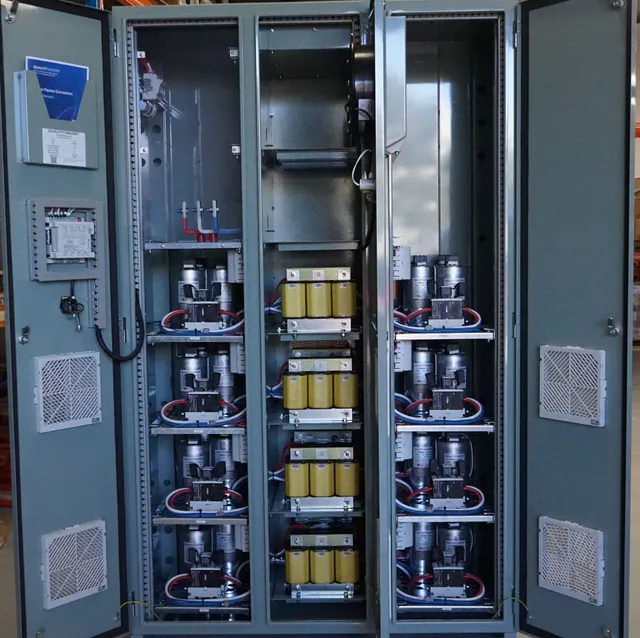
APFC Relay & Controller Repair
Diagnosis of faulty APFC relays, controller displays, CT inputs and step-switching faults. We re-verify step logic and re-calibrate target PF against the actual load profile of the Noida site, then test under light, medium and peak shift load.
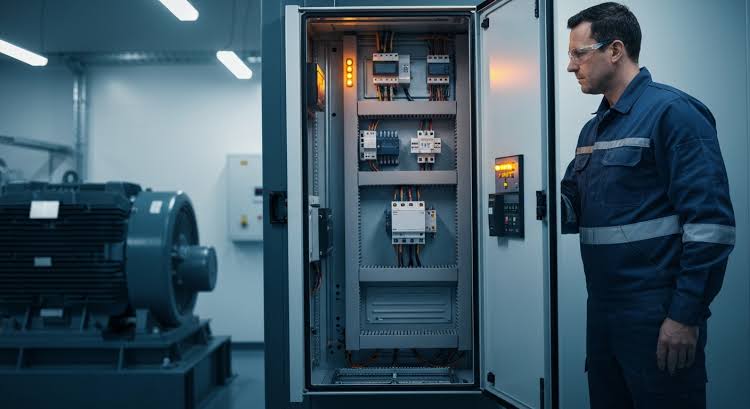
Capacitor Bank Repair & Replacement
Capacitance and ESR testing of every stage. We replace failed, bulged or leaking capacitors with correctly rated MPP / APP / heavy-duty units and verify kVAr output against panel design, including discharge resistor verification.
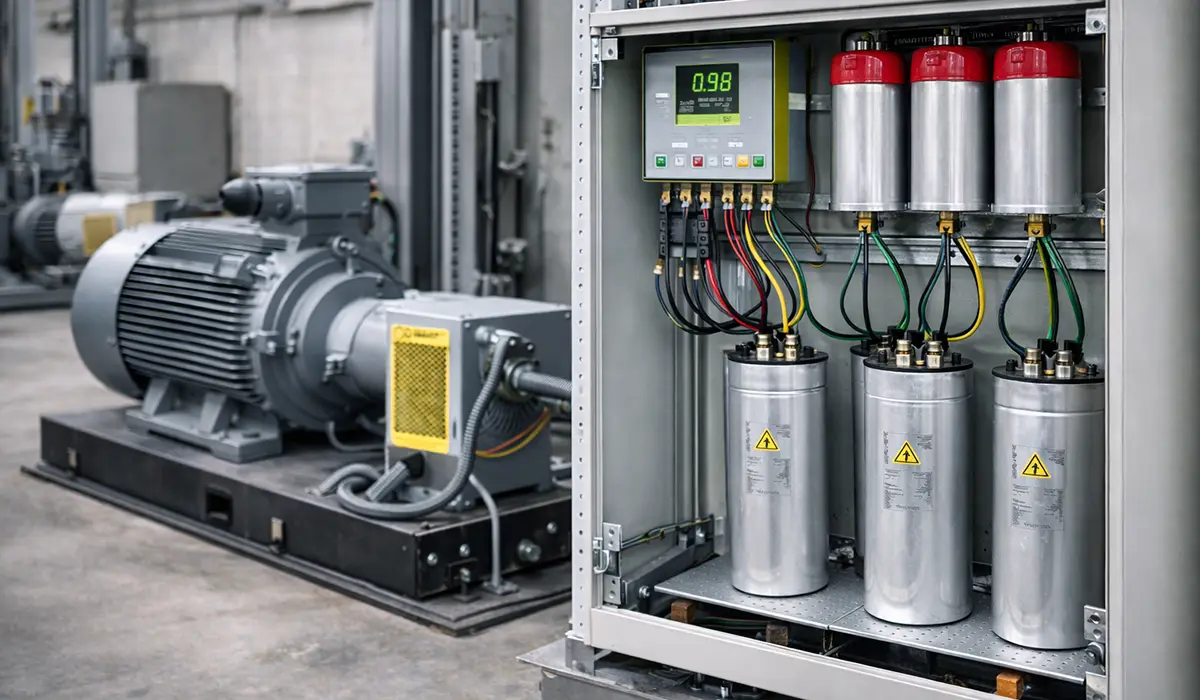
Capacitor Duty Contactor Repair
Replacement of welded, chattering or burnt CDCs with suitably rated devices, including pre-charge resistors. Where standard contactors were used at the time of panel build, we recommend upgrading all switching devices to true capacitor-duty contactors.

Fuse, MCCB & Protection Repair
HRC fuse rating verification, MCCB/MCB trip-curve review, thermal overload relay testing and coordination checks against prospective fault current. A fault-level study is available for critical Noida panels serving continuous process lines or data centres.
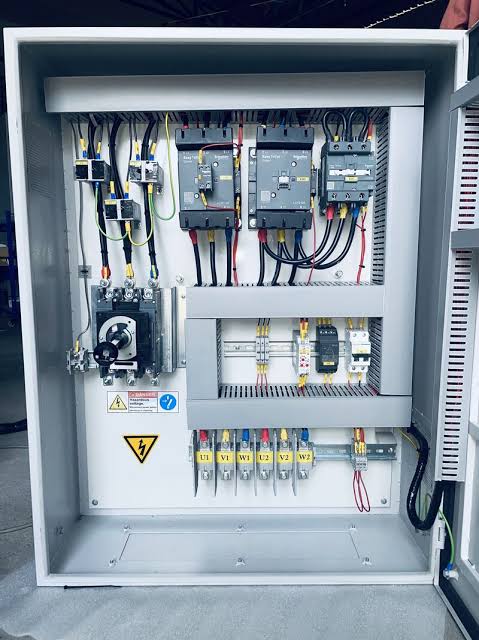
Panel Wiring, Busbar & Terminal Repair
Repair of loose terminals, burnt busbars and damaged control wiring. Full torque check and insulation resistance test before re-energisation. Ferrules and cable tags are re-done where damaged by dust or heat.
Harmonic & Power Quality Diagnosis
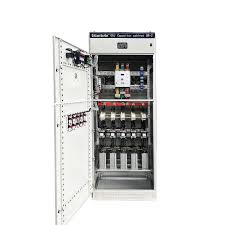
Where failures repeat, we measure THD-V, THD-I and individual harmonic orders to determine whether the panel needs detuned reactors, filter tuning or replacement capacitor ratings — a particularly common need in Noida's IT corridors.
Common Faults in Power Factor Panels — An In-Depth Breakdown
Understanding how each fault develops is the fastest way to spot it early. Below are the faults our power factor panel repair service in Noida team encounters most often in IT, industrial and commercial sites, with the technical explanation behind each.
Capacitor Degradation
Capacitors lose capacitance as the dielectric self-heals over years of service. Internal pressure builds up when the self-healing process breaks down, eventually causing bulging, leakage or rupture. Dry-type capacitors running in Noida's summer heat degrade two to three times faster than in cooler climates, and continuous IT or manufacturing loads accelerate that further because the capacitor bank gets little rest.
APFC Relay Drift & Failure
Relay CT inputs can lose calibration, the display can blank out and switching logic can become erratic. Common causes include voltage spikes from welding loads, harmonic distortion in the CT secondary from UPS and drive equipment, moisture ingress in monsoon and firmware wear. Controllers must be recalibrated against actual site load, not simply reset to factory defaults.
Capacitor Duty Contactor (CDC) Failure
CDCs carry very high inrush currents at every switching event. Repeated switching welds contacts, degrades pre-charge resistors and burns coils. Symptoms include chatter, humming, delayed drop-out and heating — often reported by site teams as "capacitor failure" when the real fault is the switching device.
Fuse Blowing on Capacitor Stages
HRC fuses blow because of capacitor breakdown, harmonic overload, loose terminals or wrong fuse rating. Repeated fuse failures are a clear sign the underlying fault must be diagnosed. Re-fusing without diagnosis is a temporary patch that keeps failing and quietly consumes maintenance hours every month.
Loose Busbar Joints & Burnt Terminals
Thermal cycling loosens busbar joints and cable terminations. Resistance rises, temperature climbs and oxidation accelerates — eventually causing a burnt terminal or fire. Noida's construction dust makes this worse because dust accumulates on joints and traps heat. A thermal scan during repair reveals hotspots that are invisible to the eye.
Harmonic Resonance
When capacitor banks are added to a network with high harmonic distortion, parallel resonance can amplify harmonic currents five to twenty times. Capacitors overheat and fail rapidly, and breakers nuisance-trip. Detuned reactors or filter tuning are often required — particularly in Noida's IT corridors where UPS and drive loads produce strong 5th and 7th harmonic content.
APFC Panel Repair Service in Noida
Automatic Power Factor Correction panels are the backbone of reactive power compensation in Noida's industrial and IT facilities. Our APFC panel repair service covers the entire control loop, switching chain and protection scheme.
An APFC panel that is not switching stages correctly — or is switching them erratically — silently bleeds money through PVVNL penalties and kVA demand charges. Every APFC panel repair in Noida we carry out begins with structured diagnosis: verifying CT ratio and polarity, checking the relay's target-PF and step-time settings, measuring capacitor kVAr per stage, and inspecting contactor and protection health against the panel's original design.
Typical repair work includes relay replacement or re-commissioning, CT replacement, capacitor stage replacement, CDC replacement, wiring correction, fuse and MCCB restoration, and full functional testing under the site's load. Where the panel design itself is inadequate — for example, too few steps for a site that has added machinery or IT load over successive expansions — we propose a staged retrofit so the controller can track the load more precisely through the shift cycle.
We also routinely correct "almost-working" panels where a replacement controller has been fitted without matching the number of steps, discharge time or CT ratio to the existing installation. In Noida's older Sector 63 units and multi-tenant commercial buildings these half-commissioned panels are common and often generate more penalties than a fully failed one, because the maintenance team believes the panel is fine simply because it is switching.
For IT campuses and multi-tenant buildings running round-the-clock operations, we plan the diagnosis and repair so that the panel is back in service within the shortest safe window — typically a planned shift change or a weekend maintenance stop.
Capacitor Bank Repair & Replacement Service in Noida
The capacitor bank is the heart of the power factor panel — and the component most affected by heat, harmonics and continuous operation in Noida.
What We Do
- Measure capacitance and ESR of every capacitor to detect weak or failed units.
- Verify kVAr output against nameplate and panel design to identify under-performance.
- Replace failed or bulging capacitors with correctly rated MPP / APP / heavy-duty units.
- Verify stage fuses, contactors and discharge resistors.
- Balance stages so switching produces smooth, uniform kVAr steps.
- Recommend detuned reactors where harmonic distortion is shortening capacitor life.
- Document pre-repair and post-repair capacitance values for the site maintenance file.
Signs Your Capacitor Bank Needs Repair
- Power factor stays low even with the panel ON.
- Capacitors run hot to the touch or show bulged tops.
- Oil leakage or staining near capacitor terminals.
- Repeated fuse blowing on the same one or two stages.
- Burnt smell or charred insulation around capacitor cans.
- Controller kVAr reading significantly lower than the installed bank.
- Audible hissing or crackling from capacitor cans — a sign of imminent failure.
APFC Relay Repair & Controller Calibration in Noida
The APFC relay is the brain of the panel. If the relay is mis-configured or faulty, even a healthy capacitor bank will not deliver the target power factor the site needs.
Relay Diagnosis
We use the relay's diagnostic menu, inject test signals into the CT circuit and compare readings against calibrated instruments. Wrong CT polarity, mismatched CT ratio and control wiring faults are common causes of "apparent relay failure" — the relay is fine, the inputs are not.
Repair or Replacement
Where a relay is repairable — loose terminals, blown internal fuse, display board issue — we repair it. Where firmware or hardware failure is confirmed, we replace with a compatible model and re-commission from scratch, including all parameters.
Calibration & Commissioning
Target power factor, step switching delays, CT ratio, number of steps, discharge timing and alarm thresholds are all calibrated to the actual Noida site load. We verify behaviour under light, medium and peak load before handover.
Capacitor Duty Contactor (CDC) Repair in Noida
CDCs are specifically designed to handle the high inrush current of capacitor switching. Standard contactors used in their place fail very quickly — a retrofit mistake we routinely correct in Noida panels.
We inspect contact condition, coil voltage, pre-charge resistance and duty rating. Welded contacts, humming coils and delayed drop-out are repaired or replaced with correctly rated capacitor-duty contactors. Where a panel was originally built using standard contactors, we recommend upgrading all switching devices to true CDCs to eliminate repeated failures.
Post-repair, every CDC is tested for pick-up voltage, drop-out voltage, contact resistance and switching time against the controller's command. Only then is it returned to service. We document the pick-up and drop-out values so that the site's next maintenance cycle has a reference point.
We also verify that the pre-charge resistors, where fitted, are intact. A shorted pre-charge resistor produces a characteristic contactor chatter on pick-up that is often mistaken for a coil fault — a five-minute check that prevents a repeat call during the next shift change.
Fuse, MCCB & Protection Device Repair in Noida Power Factor Panels
Protection devices are the panel's immune system. If they are under-sized, over-sized or worn, the panel is either vulnerable to damage or prone to nuisance tripping during normal operation.
- HRC fuse rating verification against capacitor kVAr and prospective fault current.
- MCCB / MCB trip-curve review and coordination with upstream breakers.
- Replacement of welded, charred or unreliable protective devices.
- Thermal overload relay testing and re-setting for stage current.
- Control-circuit fuse and MCB restoration.
- Discharge resistor verification to confirm safe re-switching.
- Earth-fault protection check on PFC panels with sensitive earth leakage.
- Interlocking and E-stop circuit testing.
- Fault-level study to determine whether the protection scheme itself needs revision.
- Documentation of every protective device setting for future maintenance.
- Coordination check with the main incomer to avoid upstream tripping.
- Thermal scan of fuse bases and MCCB terminals after load restoration.
Panel Wiring, Busbar & Terminal Restoration in Noida
Even when all active components are healthy, a power factor panel can fail because of loose terminals, corroded busbars or damaged control wiring. Our repair scope includes complete electrical restoration of the panel's internal infrastructure.
- Re-termination of loose power and control cables with correct lugs.
- Busbar inspection for pitting, tracking, discolouration and oxidation.
- Re-torquing of every bolted joint to manufacturer-specified values.
- Replacement of damaged control wiring, ferrules and labels.
- Insulation resistance (IR) tests on main and control circuits.
- Continuity and polarity verification of the entire control loop.
- Replacement of damaged gaskets and cable entry glands where dust or humidity ingress is a problem.
Why This Matters
Most "intermittent" panel faults — random tripping, blank controller displays, contactor chatter — trace back to a loose or corroded terminal. A proper power factor panel repair in Noida must include electrical infrastructure restoration, not just a component swap. We see this repeatedly in older Sector 63 and Bhangel sheds, where the hardware is fine but the joints have gone high-resistance through years of thermal cycling and construction dust.
Harmonic Analysis & Detuned Reactor Solutions in Noida
Repeated capacitor failures are usually a symptom of harmonics, not capacitor quality. Our engineers measure harmonic distortion, identify resonance risks and recommend the right correction — especially relevant in Noida's IT and UPS-heavy corridors.
We use power quality analysers to record voltage and current harmonics (THD-V, THD-I), individual harmonic orders, flicker, unbalance and voltage distortion over a representative shift cycle. Where the harmonic spectrum falls close to a resonant frequency with the panel's capacitor bank, detuned reactors (typically 7% or 14% tuned) or a tuned harmonic filter are recommended. In severe cases, an Active Harmonic Filter (AHF) or Static VAR Generator (SVG) may be appropriate.
If you are facing repeat capacitor failures or repeated fuse blowing, our power factor panel repair service in Noida includes a harmonic study so you fix the cause, not just the symptom. We report the harmonic spectrum, the resonance risk, and the recommended mitigation with expected results.
UPS systems in Noida's IT campuses and rectifier loads in data centres produce strong 5th and 7th harmonic content, while VFD-driven HVAC and pumps add higher-order harmonics during load transitions. Our engineers are familiar with these patterns and ensure that repair work does not disturb the harmonic-filter tuning of adjacent equipment.
Power Factor Panel Repair Guide — Fault, Diagnosis & Outcome
The table below summarises the most common power factor panel faults we repair in Noida, how we diagnose each one, and the typical repair outcome after service.
| Symptom | Likely Cause | Diagnosis Method | Typical Repair | Expected Outcome |
|---|---|---|---|---|
| Low power factor despite panel ON | Failed capacitor stages, blown stage fuses | kVAr verification, capacitance test, fuse continuity check | Replace failed capacitors and fuses | Power factor restored close to target |
| Controller display blank or alarms | APFC relay fault, CT polarity or wiring issue | Relay diagnostic menu, CT ratio and polarity check | Relay repair/replacement, wiring correction | Accurate step switching restored |
| Contactors chatter or burn out | Undersized CDC, coil failure, control voltage issues | Coil voltage test, contact inspection, load-current check | Replace with suitably rated capacitor-duty contactor | Stable switching, no nuisance trips |
| Frequent fuse blowing on stages | Ageing capacitors, harmonic overload, loose terminals | Capacitance and ESR test, harmonic measurement | Replace capacitors, tighten terminals, add detuned reactors if harmonics present | Reduced fuse failures, stable operation |
| Overheating / burning smell | Loose busbar joints, undersized cables, poor ventilation | Thermal scan, torque check, ventilation review | Re-terminate joints, improve cooling, replace damaged parts | Temperature back to normal range |
| Panel trips only at specific times | Over-correction during light load, resonance with harmonics | Load-profile logging, harmonic spectrum analysis | Reconfigure steps, adjust controller settings, add detuned reactors if required | Stable operation across load variations |
| Leading power factor at light load | Oversized capacitor bank / too many steps ON | Compare kVAr switching against measured load | Re-size stages, tune controller switching thresholds | Power factor held near target without leading |
Power Factor Penalties in Noida — What a Failed Panel Actually Costs You
PVVNL applies low-power-factor penalties and reactive-power charges under UPERC tariff orders when power factor falls below the notified threshold. For a Noida industrial or commercial consumer with a large connected load, the penalty quickly becomes a significant month-on-month cost — and a quick repair usually pays for itself within the first billing cycle.
Direct Low-PF Penalty
PVVNL levies a low-power-factor penalty as a percentage of energy or demand charges once PF falls below the notified limit. A failed panel can push PF below the limit within days, so the next industrial bill already shows the impact.
kVA Demand Impact
Poor PF increases the kVA demand recorded by the meter for the same kW load. Since demand charges are billed on kVA for most Noida industrial and commercial tariffs, a failed panel directly inflates demand charges every billing cycle.
Increased I²R Losses
Higher current at low PF increases thermal losses in cables, transformers and switchgear — energy that is paid for but delivers no useful work. These losses also raise the operating temperature of downstream equipment.
Reduced Equipment Life
Continuous operation at low PF causes transformer and cable overheating, leading to accelerated insulation ageing and earlier capital replacement — an expensive long-term effect that does not show up in the monthly bill.
If your recent Noida electricity bill shows a low-PF penalty or a reactive-power charge, a diagnostic visit is the fastest way to stop the loss. Call +91 93136 20508 to schedule a repair.
Industries & Sectors We Serve Across Noida
Our power factor panel repair teams work across every major load profile in Noida — from IT campuses and electronics plants to print, packaging, media, healthcare and modern warehousing.
IT Parks & Corporate Campuses
Sector 62 and 125-135 — UPS, server, HVAC and lift loads with high THD and precise PF requirements.
Electronics & Mobile Manufacturing
Sector 63 and 64 — SMT lines, burn-in racks and test benches with high THD-i and strict power-quality expectations.
Data Centres
Rectifier-heavy IT and cooling loads — high THD-i, zero tolerance for power quality deviation.
Print & Packaging
Sector 63 and Hosiery Complex — large motors, rectifier-driven presses and long operating hours.
Media & Film City
Studio, post-production and broadcast loads in Sector 16A — sensitive equipment, uninterruptible operation.
Hospitals & Healthcare
Sector 30 and 62 — imaging systems, OT equipment and central AC sensitive to distortion and voltage quality.
Malls, Hotels & Retail
Sector 18 corridor — HVAC, lifts and lighting with strict tariff compliance and outage avoidance.
Warehousing & Logistics
Sector 71-80, Bhangel and Noida Extension — conveyors, refrigeration and lighting across large sheds.
Emergency & Same-Day Power Factor Panel Repair in Noida
When a power factor panel fails during a critical production run, an IT service window or a patient-care shift, every hour of downtime costs money. Our emergency repair response is designed for these situations.
We coordinate priority site visits across Noida — Sector 62, 63, 64, 71-80, the 125-135 IT corridor, Hosiery Complex, NSEZ, Bhangel, Salarpur, Sector 18, Sector 76-168 and Noida Extension — for panel failures that affect production, compliance or safety. Our engineers arrive equipped with diagnostic instruments and a stock of commonly required spares (capacitors, contactors, fuses, relays) so most emergency repairs are completed in a single visit.
For critical failures, call +91 93136 20508 directly and describe the symptoms — blank controller, tripping stages, burnt smell, low PF alarm. We will advise initial safety steps and schedule the fastest possible visit. Wherever possible we coordinate with your shift supervisor, facility manager or IT operations team so the repair happens during the shortest safe shutdown window.
For plants and warehouses in Sector 71-80, Bhangel and Noida Extension, we can usually reach the site within the same working day for non-critical issues and on priority for critical failures. For data centres and hospitals, we coordinate the visit around your redundancy arrangements so that no protected circuit is left without backup.
For sites with a captive transformer and downstream sub-panels, we can also coordinate the repair with the transformer shutdown so that only one isolation sequence is needed rather than two.
Preventive Maintenance & AMC for Power Factor Panels in Noida
A structured AMC eliminates most unplanned panel failures. Our preventive maintenance plans are designed around Noida's dust, heat and harmonic-heavy IT and manufacturing loads.
Scheduled Inspection
Monthly or quarterly visits covering the full panel — controller, capacitors, contactors, fuses, busbars and cooling.
Thermal Scanning
Infrared scan of busbars, terminals and switching devices under load to catch hotspots before failure.
Component Testing
Capacitance and ESR testing of every capacitor stage; contactor contact resistance measurement on every CDC.
Cleaning & Torquing
Panel cleaning, filter replacement and re-torquing of every bolted joint to reduce thermal faults and dust tracking.
AMC scopes are sized to the panel rating and the criticality of your load. For Noida IT campuses, data centres and hospitals, we can align visits to planned maintenance windows and include quarterly thermal scans with a signed report.
Thermal Imaging & Predictive Diagnostics
Thermal imaging reveals faults that are invisible to the eye — loose joints, overloaded stages, failing contactors and degrading capacitors.
Our engineers use calibrated thermal imagers to scan the panel under normal load. A hotspot at a busbar joint, a warmer-than-normal capacitor can or a contactor running hotter than its neighbours are all early warnings. Catching these during a preventive scan usually avoids a complete failure and a costly emergency repair.
Thermal scans are included in our AMC scopes and in post-repair verification for every repair job we carry out. The report includes a thermal image, the recorded temperature, the reference temperature and a delta-T assessment with a recommended action. Noida's construction dust makes thermal scanning especially valuable because dust accumulation on busbars and terminals hides developing faults until they become a fire risk.
For sites with a monthly or quarterly maintenance schedule, thermal scans can be timed to coincide with the existing PM stop so that no additional shutdown is required. In multi-tenant commercial buildings, scans can also be scheduled floor-by-floor to avoid disrupting tenants.
Why a Pre-Repair Power Quality Audit Matters
Jumping straight to component replacement is how the same fault recurs every few months. Our repair workflow begins with a power quality audit so the root cause is understood — not guessed.
The audit captures voltage and current profiles over a representative load period, power factor behaviour across load levels, harmonic spectrum, unbalance and switching events. This lets us decide whether the fault is purely component-level, or whether the panel's design, controller settings or harmonic environment also need correction.
The result is a repair that lasts — and a documented baseline against which post-repair performance can be verified. For Noida sites planning capacity expansion or applying for tariff rationalisation with PVVNL, this baseline is valuable documentation to keep alongside the panel's maintenance file.
Where the site already has an energy-monitoring system, BMS or SCADA, we can collect additional load-profile data from those sources and cross-check it against the panel's own readings for a more accurate diagnosis — particularly helpful in IT campuses where the panel may be one of several across multiple buildings.
Our Power Factor Panel Repair Process in Noida
Every repair follows a structured four-step process so that the correct root cause is addressed and the panel is returned to service safely, within the site's shutdown constraints.
1. Site Visit & Inspection
Our engineer visits the Noida site, reviews the panel layout, inspects the controller, capacitors, contactors and protection, and records initial readings under the site's own load.
2. Fault Diagnosis
Measurements on voltage, current, power factor and harmonics are taken. Failed components are isolated and the root cause is identified before any replacement.
3. Repair & Replacement
Faulty capacitors, contactors, relays, fuses and wiring are repaired or replaced with correctly rated components. All terminations are re-torqued and tested.
4. Verification & Handover
The panel is energised and observed under representative site load. Power factor readings, step switching and protective device status are recorded and shared with your maintenance team.
Repair vs Replacement — How We Decide
Not every fault requires a new panel. Our engineers apply clear technical criteria to recommend repair, staged restoration or full replacement.
| Condition | Recommended Action | Reason |
|---|---|---|
| Isolated component failure | Repair & replace failed part | Rest of panel healthy, lower cost |
| 2–3 capacitor stages failed | Replace failed stages + verify others | Panel infrastructure intact |
| Relay / controller obsolete or unavailable | Relay replacement + re-commissioning | Rest of panel salvageable |
| Busbar / MCCB damaged | Staged restoration or retrofit | Component-level rebuild possible |
| Multiple harmonic-related failures | Repair + detuned reactors or filters | Fixing cause, not just symptom |
| Panel undersized for load profile | Redesign or upgrade | New requirement exceeds original design |
| Panel safety compromised | Full replacement | Risk to personnel and facility |
Spare Parts & Components We Supply & Fit
Our Noida repair teams are backed by a parts inventory so that most repairs can be completed on the same visit. Where a specific brand or model is unavailable, we propose a technically equivalent alternative.
- Capacitors (MPP, APP, heavy-duty, gas-filled)
- Capacitor duty contactors (CDC)
- APFC relays & controllers
- Current transformers (CTs) — all ratios
- HRC fuses & fuse bases
- MCCBs and MCBs
- Thermal overload relays
- Detuned reactors & filter components
- Control transformers & SMPS
- Push buttons, indicators, selectors
- Panel cooling fans & filters
- Busbars, lugs, terminals and wiring
Safety Standards & Compliance Followed in Every Repair
Every repair follows recognised Indian and international electrical safety standards to protect personnel, equipment and your facility's compliance posture.
- IS 8623 / IEC 61439: LV switchgear and controlgear assemblies — panel construction and testing.
- IS 13340 / IEC 60831: Shunt power capacitors — rating and safety verification.
- IS 13947 / IEC 60947: LV switchgear and contactor compliance.
- CEA Regulations: Measures for safety and electric supply.
- Lockout–tagout (LOTO) before any work begins.
- Insulation resistance and earth continuity tests before re-energisation.
- Documentation of every repair with test results and photographs.
- Use of calibrated instruments for every measurement.
- PPE compliance — gloves, insulated tools and safety glasses on every site.
- Work permit coordination with the site's EHS team.
Post-Repair Load Testing & Verification
A repair is not complete until the panel has been verified under real load. Every job closes with a documented performance test.
Functional Test
Step switching is observed at light, medium and peak site load. Target PF is achieved and held without oscillation. Relay display and alarms are tested end-to-end.
Measurement Test
Voltage, current, PF, THD and per-stage kVAr are recorded using calibrated instruments. Results are compared against the pre-repair baseline.
Thermal Check
Post-load thermal scan of busbars, terminals, contactors and capacitors confirms no hotspots remain after the repair.
Cost of Power Factor Panel Repair in Noida — What Affects the Price
Every panel is different. Rather than quote a fixed price, we provide a transparent scope and cost after diagnosis. The main factors that determine repair cost are listed below.
- Number of failed components (capacitors, contactors, fuses, relay).
- Panel rating and number of stages — larger panels take longer.
- Brand and availability of spare parts for older or imported panels.
- Whether the relay or controller needs replacement vs recalibration.
- Whether the repair is component-level or full staged restoration.
- Harmonic study or detuned reactor recommendation if repeat failures are harmonic-driven.
- Site access and shutdown window (night shifts, weekends, tenant or production constraints).
- Panel condition — complete restoration vs targeted component repair.
- AMC bundling if you choose a preventive maintenance plan.
- Distance to site from our service base — Noida Extension, Bhangel and Sector 168 may need scheduling coordination.
Call +91 93136 20508 or email transparentenergysolution@gmail.com with your Noida site details for a transparent estimate.
Recent Power Factor Panel Repairs Across Noida
A snapshot of typical repairs completed by our team in the Noida belt. Site names are kept generic to respect confidentiality, but the technical scenarios are representative.
Sector 63
Electronics manufacturing unit with a 400 kVAr APFC panel. Relay failure plus three failed capacitor stages. Repair restored PF from 0.78 to 0.96, and the reactive-power charge was removed from the next PVVNL bill.
Sector 62
IT campus with recurring fuse blowing. Harmonic study identified UPS-driven 5th and 7th order resonance. Detuned reactors installed; repeat fuse failures stopped within two billing cycles.
Sector 64
Auto-component plant with APFC panel tripping during shift transitions. Over-compensation during low-load windows diagnosed; controller thresholds and step configuration corrected.
Hosiery Complex
Packaging unit — blank controller display on the main PFC panel. Relay replaced, CT polarity corrected, re-commissioned with new parameters. Full functional verification under load.
NSEZ
Export-oriented unit — CDCs welded and contactors chattering through the summer. Replacement with correctly rated CDCs, plus control wiring and pre-charge resistor restoration.
Noida Extension
Group housing society — burnt busbar terminals at the capacitor bus. Busbar restoration, re-termination and post-repair thermal scan. No recurrence in the following nine months.
Power Factor Panel Modernization & Retrofit Solutions in Noida
For older Noida panels that repeatedly fail, modernization is often more cost-effective than repeated repairs.
We retrofit existing panels with modern APFC controllers, detuned reactors, heavy-duty capacitors and improved cooling — preserving the enclosure and busbar infrastructure while upgrading the electrical and control layers. Retrofit scopes are sized to your current load profile so that the controller can follow the load more precisely through the shift cycle.
Modernization typically extends panel life by eight to ten years and often pays back within 12 to 18 months through reduced penalties, lower component failure rates and fewer unplanned shutdowns. For Noida units that have grown their connected load since the original panel was installed, modernization also brings the panel back into compliance with current UPERC tariff thresholds and the site's actual production profile.
Energy Monitoring & Smart Panel Upgrades
Smart panel upgrades let you see what is happening inside your power factor panel — without opening it, and without waiting for the monthly bill.
Real-Time PF Monitoring
Energy meters and IoT-enabled monitors stream PF, kVA, kW, THD and stage-status data continuously to your dashboard, SCADA or site BMS.
Alerts & Logs
Alarms for low PF, stage failure, over-temperature or communication loss — before they escalate into penalties or downtime.
Performance Reporting
Monthly reports on PF trend, kVAr delivered vs demand and penalty exposure — useful for tariff reviews and internal audits.
Summer & Monsoon Readiness Checklist for Noida Power Factor Panels
Noida's peak summer load and monsoon humidity each stress panels differently. Use this seasonal checklist to prevent failures before they happen.
Pre-Summer Checklist
- Clean and test all cooling fans and filters.
- Thermal scan under peak load.
- Verify capacitor kVAr output; replace weak stages.
- Check contactor pick-up/drop-out and coil temperature.
- Re-torque busbar and terminal joints.
- Confirm that internal panel temperature stays below design limits during peak IT or production load.
Pre-Monsoon Checklist
- Insulation resistance test on main and control circuits.
- Check gaskets, panel sealing and cable entry glands.
- Verify space heater or anti-condensation circuit (if fitted).
- Inspect for corrosion on busbars and terminals.
- Test earth continuity and earth-fault protection.
- Check cable duct and cable-trench drainage near the panel room.
How to Choose the Right Power Factor Panel Repair Partner in Noida
Not every electrical contractor can repair a power factor panel correctly. Here is what to look for.
- Demonstrated power-quality expertise — not just general electrical work.
- Proper diagnostic instruments — analysers, capacitance meters, thermal imagers.
- Component-level repair capability — not just swap-and-bill.
- Documentation — test reports, thermal scans, post-repair readings.
- Spare parts access and knowledge of multiple brands.
- Experience with harmonic-heavy environments (UPS, VFD, rectifier, data centre).
- AMC and response-time commitments for critical IT and manufacturing facilities.
- Transparent scoping and pricing — diagnosis first, quotation second.
- Local presence near Noida for emergency response.
What Our Noida Clients Say
Feedback from industrial, IT and commercial customers across Noida after power factor panel repairs by Transparent Infra And Energy Solutions.
"Our APFC panel had been causing reactive-power charges for months. Their team traced it to a drifting relay and three failed capacitor stages, fixed everything in one shift, and the next PVVNL bill showed the penalty was gone."
— Maintenance Head, Sector 63
"We had repeated fuse failures that no one could explain. Their harmonic study identified the real cause, and the detuned reactor solution they recommended finally stopped the failures."
— Facility Manager, Sector 62
"Professional, well-documented repair. They provided a full thermal scan and load-test report — something our previous contractors never did — and worked around our tenant shut-down window without any friction."
— Operations Head, Sector 18
Related Services You May Need
Power factor panel repair often goes together with these related services. We can bundle them into a single visit to your Noida site.
Glossary of Power Factor Terms
Quick definitions of the technical terms used in power factor panel repair discussions.
Power Factor
Ratio of real power (kW) to apparent power (kVA). Target is typically ≥0.95.
kVAr
Reactive power in kilovolt-amperes reactive — supplied by capacitors to compensate inductive loads.
APFC
Automatic Power Factor Correction — switching of capacitor stages by a controller.
CDC
Capacitor Duty Contactor — contactor rated for capacitor inrush current.
THD
Total Harmonic Distortion — measure of harmonic content in voltage or current.
Detuned Reactor
Series reactor (typically 7% or 14%) that protects capacitors from harmonic resonance.
CT
Current Transformer — steps down current for measurement by the APFC relay.
ESR
Equivalent Series Resistance — internal resistance of a capacitor; rising ESR indicates aging.
Leading PF
Power factor where current leads voltage — usually from over-compensation.
Coverage & Response Times Across Noida
We coordinate repair visits across the whole Noida district — including Sector 1-62, 63-75, 76-168, Hosiery Complex, NSEZ, Bhangel, Salarpur, Mamura and Noida Extension — with priority response for critical failures.
| Area | Standard Response | Emergency Response |
|---|---|---|
| Sector 1-30 (central and commercial) | Same-day visit | Priority response |
| Sector 44-62 (IT and residential) | Same-day visit | Priority response |
| Sector 63-80 (industrial and warehousing) | Same-day visit | Priority response |
| Sector 82-100 (mixed-use and housing) | Same-day or next-day visit | Priority response |
| Sector 110-168 / Noida Extension | Next-day visit | Priority response |
| Hosiery Complex / NSEZ / Bhangel | Next-day visit | Priority on coordination |
| Salarpur / Mamura / Baraula / Chhapraula | Scheduled visit | Priority on coordination |
For urgent repair, call +91 93136 20508. For scheduled work, email transparentenergysolution@gmail.com with site location, panel rating, make and fault symptoms.
Need a Power Factor Panel Repair in Noida Today?
Talk to our engineers about your panel fault, Noida site location and shutdown window. We coordinate repair visits across Sector 62, 63, 64, 71-80, the 125-135 IT corridor, Hosiery Complex, NSEZ, Noida Extension and the entire Noida belt.
Call +91 93136 20508Frequently Asked Questions — Power Factor Panel Repair in Noida
Answers to the questions we hear most often about power factor panel repair, APFC panel servicing and power quality restoration in Noida.
Power Factor Panel Repair Service Across Noida
Our engineers cover all major industrial, IT, commercial and residential locations across Noida district. Find your area below and book a repair visit.